
You Can't Out-Engineer Your Experts...You Can Out-Question Them

The most expensive technical decisions I've watched executives make weren't made by executives.
They were made by a smart engineer or a trusted vendor — confidently, competently, with a slide deck — while the executive nodded along. Not because the leader was careless. Because the proposal sounded right, used words they didn't fully own, and came from someone they'd hired precisely because that person knew more than they did.
Here's the trap: your experts are almost never wrong. They're answering a different question than the one your business is actually asking. The architect designs for the scale they've seen before. The vendor sells the pattern that works for their biggest customer. The estimate gets repeated until it sounds like a fact. None of that is incompetence. It's just unexamined default — and default is what costs you.
I'm a Martech architect and executive advisor. I spend my days in the seam between technical teams and the leaders who fund them, translating one to the other. Lately I've been rebuilding a marketing data platform for a national nonprofit, and three decisions from that work keep proving the same point: the leader's job isn't to know the answer. It's to ask the question that exposes the default.
You don't need to out-engineer the people you hired. You need to out-question them. Here's what that looks like in practice.
1. The "Industry Standard" Is Probably Built for Someone Else
We needed a system to recognize the same person across email, web, and phone — what's called identity resolution. The development team came back with a textbook design: a dedicated database, a caching layer, automatic record-merging, the works. It was a clean, professional architecture. It's also what every reference guide and every senior engineer will reach for, because it's correct.
The problem wasn't correctness. It was scale. That architecture is built for a consumer app doing thousands of lookups per second. We were going to do single digits per second at our busiest moment. The "standard" design ran roughly $60–250 a month and carried real operational complexity. The right-sized version — same job, far simpler — ran about $5–70 a month.
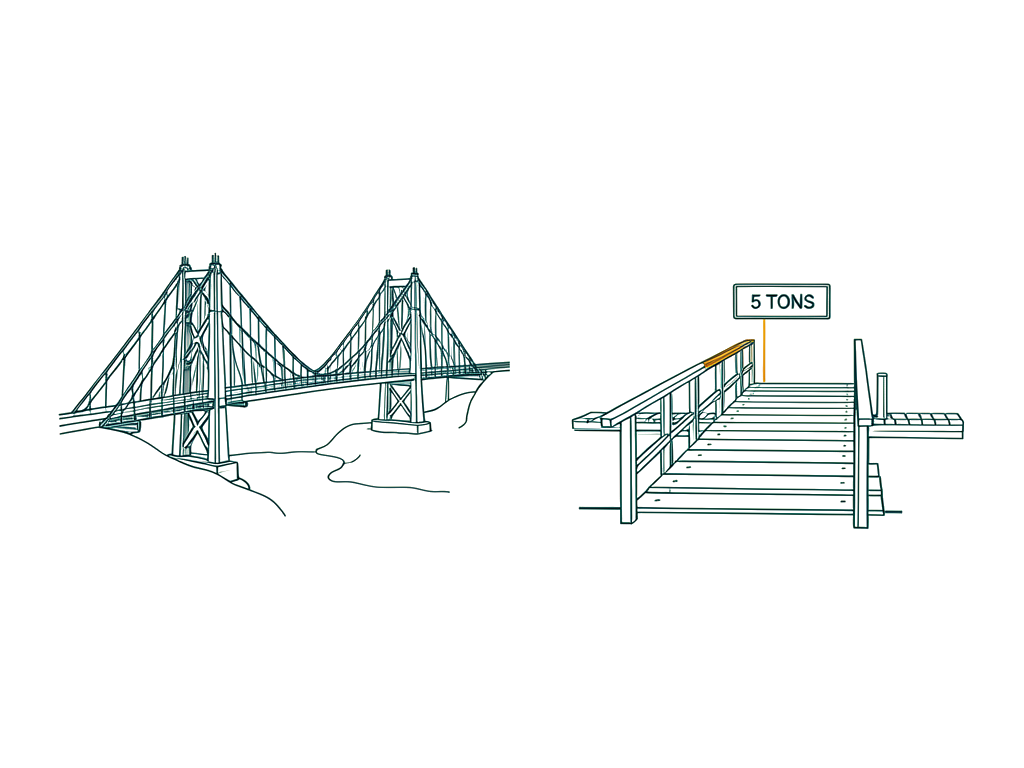
Here's what was really going on, and it's worth understanding because it happens constantly. Absent hard numbers, a good engineer designs for the unknown. The instinct is an honorable one: make sure nothing can ever break, so build for the worst case you can imagine. But "guarantee it never breaks" and "match what we actually need" are different design goals, and the gap between them is pure cost. Usually nobody has done the unglamorous work of researching the real load — so the team builds an industrial bridge rated for tanks, when what the situation called for was someone to survey the actual traffic and post a sign that reads weight limit: 5 tons. The sign is cheaper, faster, and completely adequate — as long as someone bothered to weigh the trucks.
We didn't cut corners. We wrote down explicit upgrade triggers: if we ever cross 50 requests per second, add the cache; if we see more than 50 conflicts a day, revisit auto-merging. The expensive architecture wasn't eliminated. It was deferred until the business actually needed it.
Executive Insight #1: Absent real numbers, even excellent engineers design for the unknown — building to guarantee nothing ever breaks rather than to match what you actually need, because "never fails" is the safe default when no one has measured the real load. "Industry standard" is that instinct hardened into a template, sized for a company far bigger than yours. Sometimes you don't need the industrial bridge — you need someone to weigh the traffic and post a weight limit: 5 tons sign. Your job is to push for that research, and to insist on the version sized for the business you actually run, with a written path to upgrade when reality demands it.
The question that unlocked this wasn't technical. It was: "What size of company is this design built for, and how does that compare to us?"
2. The Estimate Is a Guess Wearing a Suit
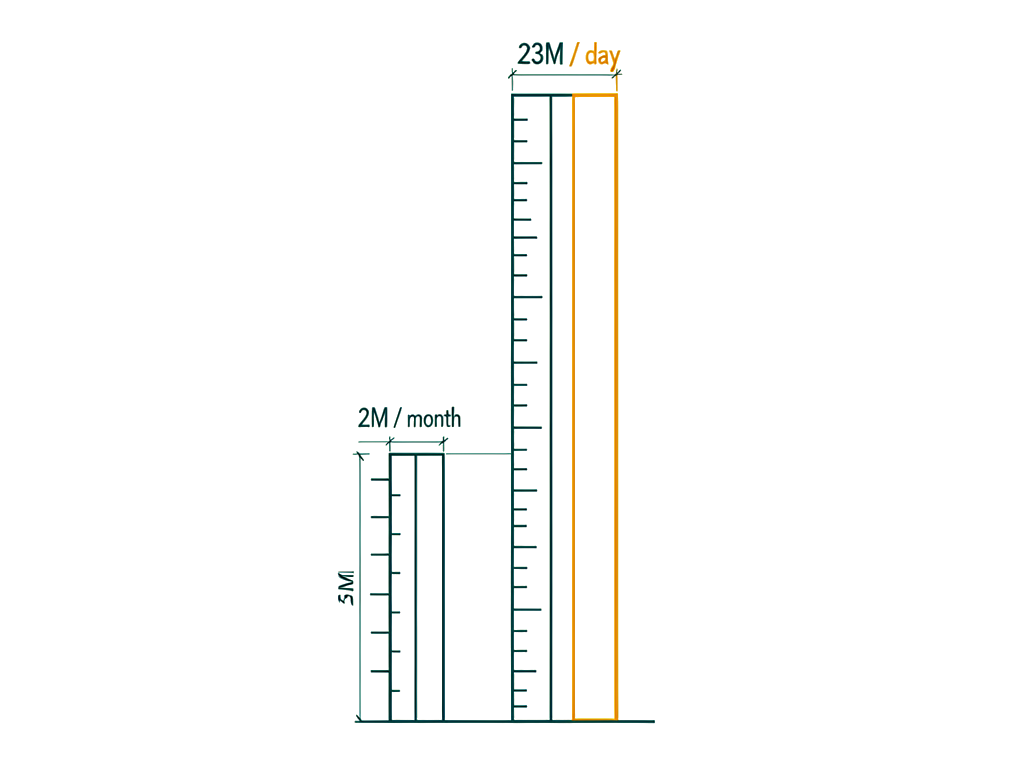
When the engagement was scoped, everyone agreed on the number: about 2 million events a month flowing through the system. It was in the proposal. It shaped the budget, the architecture, the timeline. Nobody questioned it, because it had been said enough times to feel like a measurement.
It wasn't a measurement. It was a guess. When we actually counted the live data from a single source, the real number was 23 million events — per day. That's roughly a 300x miss. Every assumption about storage, cost, and how often the system needed to run was built on a foundation that was off by two orders of magnitude.
The fix was almost embarrassingly cheap: before committing to the architecture, we ran a query that simply counted the data. An afternoon of work caught a problem that would have cost months had we built on the original number.
This is the same root cause as the over-built bridge, just pointing the other way. When nobody researches the real load, you're exposed in both directions: you either build a fortress against traffic that never comes, or you get flattened by traffic you never saw. Designing for the unknown cuts both ways — pad too much and you waste, guess too low and you get blindsided. The cure is identical either way: weigh the trucks before you design the bridge.
Executive Insight #2: A number that gets repeated is not a number that's been verified. Estimates have a way of hardening into "facts" through nothing but repetition — and an unverified number is dangerous in both directions, inviting either a wasteful over-build or a blindsiding under-build. Before you let a figure drive a budget or a design, ask what it's actually based on, and whether anyone has measured the real thing instead of guessing at it. The verification is almost always cheaper than the mistake.
The question here was: "Is that a measured number or an estimated one — and can we check it before we build on it?"
3. Faster Isn't Safer
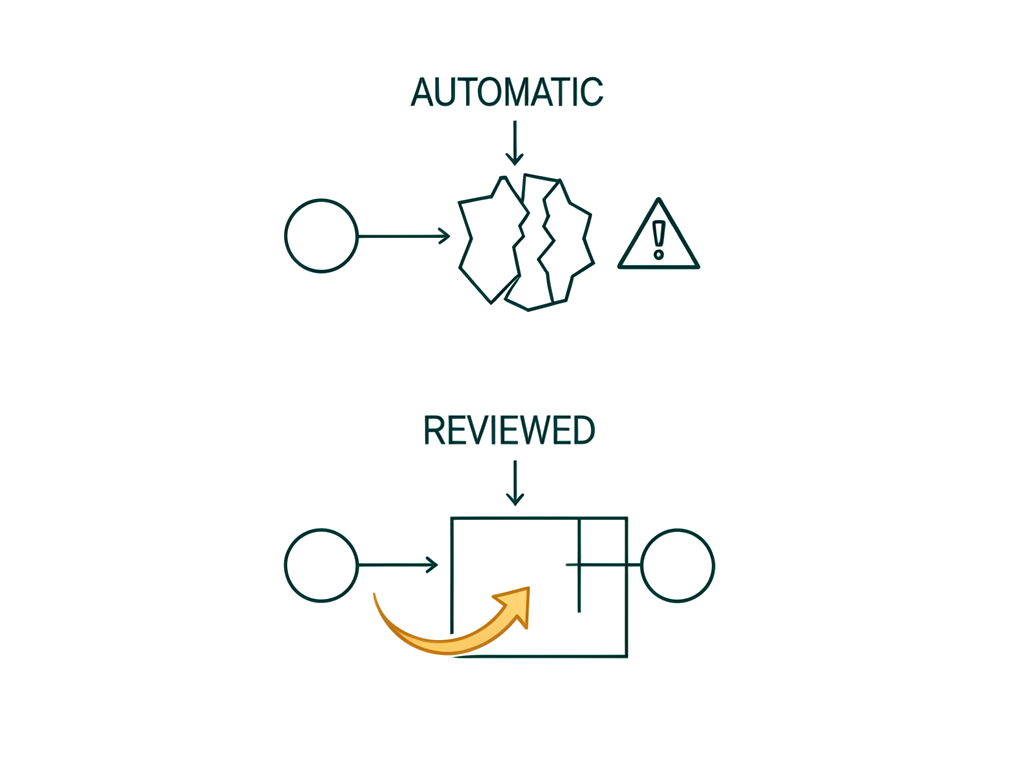
The identity system raised a tempting option: automatically merge records the system thinks belong to the same person. It's faster. It's cleaner. It's what the efficient design does. And we deliberately chose not to do it — at least not yet.
Here's why. This is a donor organization, and its entire relationship with the public runs on trust. If the system silently merges two different donors into one record, that error is nearly invisible. There's no alarm. The data just quietly becomes wrong — wrong giving history, wrong communications, potentially one person's information exposed to another. By the time anyone notices, the damage is done and hard to unwind.
So instead of automatic merging in the fast path, we route uncertain matches to a person for review. Slower. Less elegant. But every merge is deliberate and reversible — and in a context where a single silent error becomes a trust catastrophe, that trade is obvious.
Executive Insight #3: "Faster" and "more automated" are not free upgrades — they carry a hidden cost in reversibility. Before you automate a decision, ask what happens when it's wrong, whether you'll even notice, and whether you can undo it. Where errors are silent and damage is hard to reverse, a slower human-checked process isn't inefficiency. It's insurance.
The question that mattered: "If this gets it wrong, will we know — and can we take it back?"
What These Three Have in Common
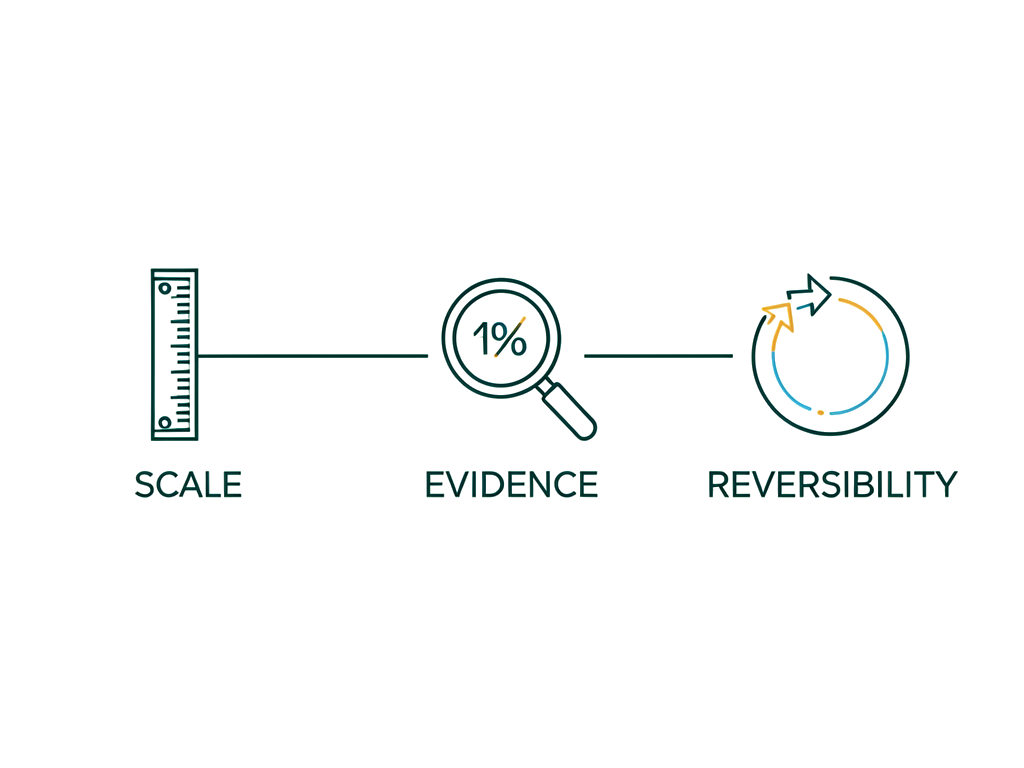
Look at the three decisions together and the same shape appears every time.
In each case, a competent person proposed something reasonable. The standard architecture was reasonable. The scoping estimate was reasonable. Automatic merging was reasonable. Nobody was wrong on the technical merits. And in each case, the better business decision came from a question that had nothing to do with technical skill — and everything to do with business context the expert simply didn't have.
That's the part most leaders get backwards. They think the way to govern technical work is to understand the technical work — to learn enough to evaluate the engineering on its own terms. You will lose that race. Your experts will always know more about the technology than you do. That's why you hired them.
But there's a different game you can win, and it's the one that actually matters. You own the context they're missing. You know the company's real size, its real risk tolerance, its real constraints. The expert is optimizing for technical correctness. You're optimizing for fit. And fit is decided by three questions you can ask without writing a line of code:
- Scale — "Whose situation is this built for?" Best practices are inherited from somewhere. Find out where, and whether it matches you.
- Evidence — "What is this number actually based on?" Separate what's been measured from what's been assumed, before either one drives a decision.
- Reversibility — "If we're wrong, will we know, and can we undo it?" Weigh speed and automation against the cost of a silent, permanent mistake.
Notice what all three questions really do: they replace the unknown with your reality. Left without context, even a great engineer designs against the worst case they can imagine — padding the budget, the architecture, and the timeline against risks that may never apply to you. That padding is the price of your silence. So the most valuable thing you bring to a technical conversation isn't an answer — it's the spec only you can give: here's the load we actually expect to carry, here's what we can tolerate going wrong, here's where a failure is survivable and where it's catastrophic. Hand your experts your real risk planning, your real scale needs, and your real tolerance for failure, and you let them design the bridge for the trucks that will actually cross it — instead of the trucks they're afraid might. That's not meddling in their craft. It's giving their craft a target.
A few things about how to actually use these. Ask them as a collaborator, not a prosecutor. You're not challenging your expert's competence — you're handing them context they didn't have, so the two of you can land on the right answer together. The good ones will welcome it; a sharp engineer wants to know the real scale and the real risk tolerance, because it makes their design better. And when you're dealing with an outside vendor, treat these as a stress test: a vendor who can't tell you whose scale their product assumes, or where their numbers come from, or what happens when their system is wrong, is a vendor whose dependency you should be very slow to deepen.
This isn't about second-guessing everyone or slowing every decision to a crawl. It's about knowing the three places where reasonable, competent, expert advice most often points in the wrong direction for your business — and having the questions ready when it does.
You can't out-engineer your experts. You don't need to. You just need to out-question them.
“You can't out-engineer your experts. You don't need to. You just need to out-question them.”
Where Are You?
Think about the last significant technical decision your team or a vendor brought you. Run it back through the three questions.
Whose scale was it built for? What were its key numbers actually based on? And if it's wrong, will you know — and can you undo it?
If you can't answer all three, you don't have a technology problem. You have a question problem — and that one's yours to fix. Want a second set of eyes on a decision that's in front of you right now? Let's chat.
Got a decision like this in front of you right now?
A second set of eyes, applied to your specific situation.
Quick Reference: Three Questions to Ask Any Technical Expert or Vendor
Question | What You're Really Asking | The Default It Catches | Ask It When |
|---|---|---|---|
Scale | "Whose size and situation is this built for?" | Inheriting an architecture or cost structure built for a far bigger company | Any "best practice," reference architecture, or vendor's flagship pattern |
Evidence | "Is this number measured or assumed?" | Letting a repeated estimate harden into a fact that drives budgets and builds | Any figure that's shaping scope, cost, or timeline |
Reversibility | "If this is wrong, will we know — and can we undo it?" | Trading away safety for speed on decisions that fail silently and can't be reversed | Any move to automate, merge, delete, or remove a human from the loop |
Nate is the founder of PathPractical — executive advisory for technology roadmapping, planning, and architecture. He helps business leaders translate technical complexity into decisions they can act on.
Want to work through a decision like this together?
Reach out and let's talk about where PathPractical could help your team.
Notes
The three examples in this piece are drawn from a live client engagement and have been anonymized — the client is unnamed and specific figures are rounded and generalized to illustrate the principle without exposing any organization's data or architecture.

Chat with the author
If you'd like to make a connection and perhaps collaborate on something:I'd love to talk with you!No matter if you want to build your professional network,or think there might be a great opportunity to to work together or partner.