
Productize the Diagnosis: How Agencies Package and Price Discovery as a Product

Most agencies are restaurants without a menu. You, perhaps a potential customer, sit down and ask what things cost, but the chef says "it depends," then disappears into the kitchen for two weeks to create a custom priced meal & menu for you. Your probably not even hungry by the time they come back and you decipher what's on this strange hand drawn menu.
I'm a Martech architect and executive advisor. I worked first as a senior leader inside commercial agencies, and then founded and built my own agency focused on the nonprofit sector, which has been growing for ten years now. I've been the chef in that kitchen more times than I can count. These days I coach agency owners through the work of building a menu, and the most useful thing I've learned is that almost everyone starts building it from the wrong end. Which is to say they start with the ingredients, not with the culinary experience they are trying to deliver.
The standard advice says to package your deliverables into three tiers, slap a price on each, and call yourself productized. "I see you've chosen the Bronze option tonight, madame, lovely choice." Owners try it, scope creep blows through the tiers within a quarter, and they quietly go back to custom proposals. Or they show this to clients and the clients don't see the value. "This work doesn't look like what I need, can we chop X or Y out, I have a food allergy!" The problem with the standard approach to productizing is that it starts with the price, which should be the last thing you settle when you're trying to solve someone's problem. The first thing you should put on the menu is the one service every engagement already begins with, the one you're probably giving away for free in your sales calls: the diagnosis. It's also what every good restaurant does: start with something delightful that builds trust in the dishes to come.
Let's see how that works, why it fixes the margin problem AI is already creating for a lot of agencies, and how to turn the custom work you've already sold into products with predictable effort and predictable profit.
What a "productized service" actually is

The phrase gets thrown around loosely, so it's worth borrowing a definition from the people who study it. Researchers in service marketing describe a well-defined service product as having three traits: it's specified (a formal, standardized offer with a clear scope), it's branded (it has a name), and it's priced (the price is stated up front).¹ Their starting observation will sound familiar to any agency owner: many services are so intangible and loosely defined that customers struggle to understand what they're getting for their money, which makes those services hard to position, differentiate, and sell.¹
Notice the order. Specified comes first and priced comes last. Most of the "productize your agency" content online is written by companies that sell client portals and subscription billing tools, so it naturally jumps straight to the pricing page. But a study of small professional service firms found that the real work of productizing happens upstream, in three practices: standardizing what the offer includes, making your expertise tangible to the client, and systematizing the processes and methods your team uses to deliver it.² You can't put a reliable price on something your team does differently every time.
That's why the starting point matters so much. If the first thing you productize is your most variable work, you'll be fighting scope creep forever. If it's your most repeatable work, the product almost builds itself.
Move 1: Put the diagnosis on the menu first
What it is. Every good engagement starts with someone figuring out what's actually wrong. In most agencies that diagnosis happens informally during the sales process: a few discovery calls, a look at the client's analytics, a sketch of a plan in the proposal. It takes real senior time, it produces real insight, and the client gets it for free whether they sign or not.
Productizing the diagnosis means turning that work into a named offer with a fixed scope, a fixed turnaround, a fixed price, and a concrete deliverable, typically a findings report and a prioritized roadmap. Think "Marketing Operations Audit" or "Martech Roadmap," sold for a set fee and delivered in two or three weeks. Agency consultant Karl Sakas calls this paid discovery, defines it as "an initial mini-project that prospective clients must buy" before you propose anything larger, and notes that most agencies charge $3,000 or less for it.³ He's also explicit that a paid one-off consulting call doesn't count, because it doesn't give you enough information to write a good follow-up proposal.³
I learned this at my own agency, through a pattern I kept running into with nonprofit clients. The people I worked with usually knew their martech stack was holding the organization back, but they struggled to make a clear case to their leadership for where and how it needed to evolve: which platforms to change, what staffing it would take, and what training their teams would need to actually use it. Most of these organizations simply didn't have that kind of technical expertise on staff, so the case never got made, or it got made in language leadership couldn't act on. I turned my agency's discovery process into a defined martech platform audit. On the agency side, it productized discovery work that had been happening informally, and it gave me a reliable way to understand scope and set pricing before committing to a larger engagement. On the client's side, it turned out to be far more valuable than I expected. The audit became an advocacy asset: an independent assessment, written for leadership, that my client contacts could carry into budget conversations and use to push for the funding the work required.
Why it works for both sides. For the client, it's a low-risk first purchase with something tangible at the end, which is exactly the "make your expertise tangible" practice the research describes.² Often the person who hires you isn't the person who controls the budget, and a well-built diagnosis gives your champion an outside, credible document to put in front of the people who do. For the agency, you get paid for work you were already doing, you find out what the client is like to work with before committing to a long retainer, and you walk out with a scoped, evidence-based proposal for phase two instead of a guess. The diagnosis is the item on the menu that sells the rest of the meal.
“The diagnosis is the item on the menu that sells the rest of the meal.”
The limit. A diagnosis only works as a front door if it's genuinely useful on its own. If the roadmap is a thinly disguised sales pitch, clients will feel it, and you'll have trained them to distrust your next proposal. Give them something they could hand to another agency (or their own team) and still get value from. Paradoxically, that's what makes them want to hire you to do it.
How to start. Write a one-page spec for the diagnosis you already do: what it's called, who it's for, what's included, what's explicitly excluded, how long it takes, what it costs, and what happens next. Then design the final deliverable for the reader one level above your client contact, because that's who it will end up in front of. If you want to make the price easier to swallow, offer to credit the fee toward the first phase of work.
Move 2: Find the product hiding in the work you've already sold
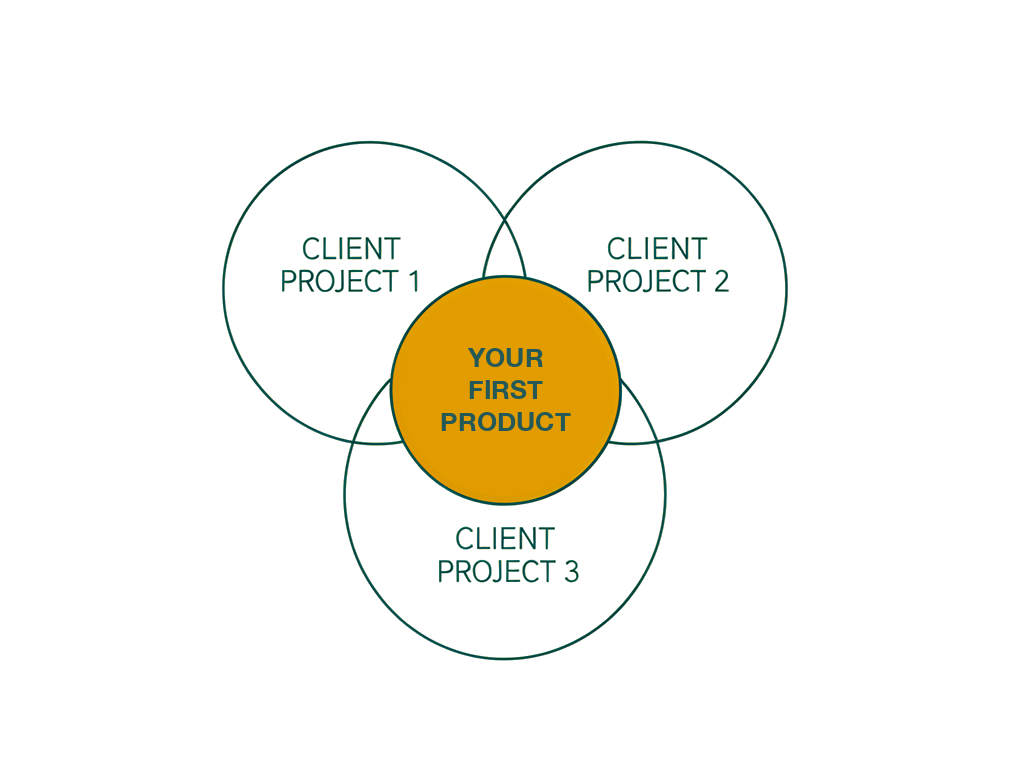
What it is. Once the diagnosis is on the menu, the next products are usually sitting in your project history. The custom engagements you've sold over the past year or two feel unique while you're delivering them, but most of them share a common core. The website rebuild always starts with the same content audit. The CRM implementation always involves the same data cleanup and the same pipeline configuration. The marketing automation project always needs the same lifecycle email foundation.
The method is not complicated. List your last ten engagements. For each one, write down the major steps your team actually performed. Mark the steps that show up in most of them, then go back through your time tracking and figure out honestly how long each of those steps took. That recurring core, with its real effort attached, becomes a module with a fixed scope and a fixed price. Everything outside the core becomes either a named add-on with its own price or a piece of work you deliberately keep custom. (Honest time estimates matter a lot here. If your team's estimates have always been optimistic, your first fixed prices will be too.)
This also answers the worry I hear most from owners who like the idea of productizing but are nervous about their existing clients. You don't rip up existing contracts mid-stream. You re-paper them at renewal around the standardized core, so the client keeps getting what they value and you stop absorbing the variability for free.
Where you'll get stuck. This is the step where most owners stall, for an entirely understandable reason. It competes for the same hours as client delivery, and client delivery always wins. A cross-case study of sixteen productization efforts found that the payoff comes from tying the offer to the underlying business processes, IT systems, people, and data,⁴ which is another way of saying the real work is operational plumbing, the unglamorous kind. That plumbing is easy to postpone indefinitely.
Getting unblocked. This is the part of the work I most often do with owners rather than just advising on it. My coaching is less therapist and more accelerator: I'll run the project-history audit alongside you, write the first module specs, and map the delivery process with your team, so a project that would otherwise drift for a year ships in a few weeks. Whether you do it with help or on your own, block a fixed amount of time on the calendar for it every week and treat it like a client deadline.
Stuck turning your custom work into products?
A working session to pick your first productized offer: what to package, how to scope it, and what to charge.
Move 3: Let AI turn your efficiency into margin
What it is. Here's the uncomfortable math AI introduces for agencies that bill by the hour or by time and materials. As your team gets faster with AI tools, the same deliverable takes fewer hours, so the invoice for the same outcome gets smaller. Clients have noticed. Roughly one in three agencies in a 2025 survey of more than 180 firms reported that clients had already asked them for an "AI discount," meaning a lower price because the work supposedly takes less effort now.⁵ The CFO of one software services firm put the long-term risk bluntly: "T&M is just going to end up being a race to the bottom."⁶
Productized pricing flips that dynamic. When the price is attached to a defined outcome instead of the hours behind it, every hour AI saves you becomes margin you keep. A fixed price is how your AI efficiency stops being your client's discount and starts being your profit. And the standardized, documented steps you identified in Move 2 are exactly the kind of work AI and automation tools (Claude, n8n, and the automation built into most modern CRMs) handle best: intake, research summaries, first drafts, data cleanup, routine reporting.
“A fixed price is how your AI efficiency stops being your client's discount and starts being your profit.”
This also explains why value-based pricing, the option consultants have been recommending for years, hasn't swept the agency world. Only 18% of digital agencies reported using value-based pricing in 2025, a small minority.⁷ Pricing purely on the value delivered is hard to do well and hard to sell to procurement departments. A productized price, built on a known scope and known effort, is the practical middle ground most agencies can actually run next month.
The blocker. You can't automate a process you haven't written down. Agencies that try to bolt AI onto unstandardized, every-project-is-different delivery tend to get faster at producing inconsistency. The margin only shows up after the specification work in Move 2, and only if the time AI frees up gets filled with more sold work rather than quietly absorbed.
The mental model for change. Treat the automation layer as infrastructure for the agency, the same way you'd treat a CRM or a project management system: intake forms, delivery workflows, templates, and reporting that run the same way every time. This is hands-on build work, and it's a big part of what I do with agency owners as a martech architect. Start with the single most repetitive step in your most common module, automate it, measure the hours it saves for a month, and put those hours on the record. That number is your case for doing the next one.
Not on your menu
Productizing is a portfolio decision, not an identity, and the research is honest about the downside. The same paper that defines productized services warns that heavy standardization can cost a firm its creativity, pointing to the difference between a strategy firm that sells individualized, breakthrough thinking and a firm that sells well-developed, repeatable solutions.¹ It cites earlier work finding that, in professional services, too much specification can become "coercive, lowering employees' motivation and value-creation capabilities."⁸
In practice, the work that should usually stay custom is the work where the answer is genuinely unknown going in: brand strategy, creative concepting, messy organizational transformations. The good news is that a productized diagnosis is often the best way into exactly that kind of work. The audit tells you, and the client, whether the next step is a standard module or a custom engagement, and you get to price each one appropriately. Productize the repeatable parts so your senior people have more time for the parts that can't be repeated.
Pretty picture or delicious meal?
You've seen the recipe: put the diagnosis on the menu first, find the products hiding in the custom work you've already sold, and let AI turn that standardization into margin instead of a discount. Any agency that has made it through its first year already has the raw material for all three, because a year of sold work is enough history to find the patterns. What most of them lack is the time and the operational scaffolding to take this out of the cookbook and into the kitchen.
Agencies that keep pricing every deal from scratch are going to spend the next few years explaining to clients why their invoices aren't shrinking along with their hours.
Start this week: pull up your last ten projects, find the diagnosis you keep giving away for free, and write the one-page spec for it. Are you ready to stop being the restaurant without a menu? If you want to get there in weeks instead of quarters, that's exactly the kind of build I help agency owners do. Book a session and let's put your first product on the menu together.
Quick Reference: Productizing Your Agency
Move | What you productize | Why it works | Where to start |
|---|---|---|---|
1. Productize the diagnosis | A fixed-price audit or roadmap that opens every engagement | Clients get a low-risk first step; you get paid for discovery and a scoped phase-two proposal | Write a one-page spec: name, scope, exclusions, timeline, price, next step |
2. Find the product in sold work | The recurring core of your past custom engagements | Turns variable delivery into fixed-scope modules with known effort and margin | Audit your last 10 projects; time the steps they share |
3. Let AI build margin | The automation layer behind your standardized steps | Under a fixed price, every hour AI saves becomes margin instead of a client discount | Automate the most repetitive step in your most common module; measure for a month |
Keep it custom | Strategy, creative, and transformation work with unknown answers | Over-standardization kills creativity and motivation | Let the diagnosis decide what's next: module or custom |
Nate is the founder of PathPractical, offering technology advice and business coaching for executives and agency owners. He helps leaders translate technical complexity into decisions they can act on, and helps agencies build the systems that make their offers profitable.
References
- Productized services are specified, branded, and priced; loosely defined services are hard to position, differentiate, and sell; heavy productization can cost creativity: Wirtz, Fritze, Jaakkola, Gelbrich & Hartley, "Service Products and Productization," Journal of Business Research, 2021 (open-access preprint)
- Productization in small professional service firms rests on three practices: standardizing the offering, making expertise tangible, and systematizing processes and methods: Jaakkola, "Unraveling the practices of 'productization' in professional service firms," Scandinavian Journal of Management, 2011
- Paid discovery defined as a required first mini-project; most agencies charge $3,000 or less; a one-off paid call doesn't qualify: Karl Sakas, "Paid Discovery," Sakas & Company
- Across 16 cases, productization improved manageability by linking offerings to processes, IT, people, and data: Harkonen et al., "Exploring the benefits of service productisation: support for business processes," Business Process Management Journal, 2021
- Roughly one in three agencies reported client requests for "AI discounts": Productive, "Agencies in the AI Era: Between Hype and Reality," 2025
- Services-firm CFO on time-and-materials pricing in the AI era: "a race to the bottom": Very Good Ventures, "The Efficiency Trap: Why AI Is Forcing Services Firms to Rethink Pricing"
- Only 18% of digital agencies used value-based pricing in 2025; preferred pricing models vary by agency type: Promethean Research, "Pricing Models Follow Agency Archetypes," 2026 State of Digital Services Report
- Too much specification in professional services can become "coercive": Tuominen & Martinsuo (2019), as quoted in Wirtz et al., 2021